

ISM Students Earn National Recognition at Global Physics Summit
Posted in ISM Stories News Story
Two ISM Graduate Students in Professor Del Gado’s lab, Rose Tchuenkam Batoum and Logan Bayer, were recognized for their research at the American Physical Society (APS) Global Summit, one of the largest and most influential gatherings in the field of physics.
Bringing together tens of thousands of scientists from around the world, the annual summit serves as a hub for sharing new discoveries, fostering collaboration, and highlighting emerging leaders across disciplines.
Advancing Soft Matter Research
Both Rose and Logan presented research focused on soft materials, complex systems that are foundational to biological tissues and everyday products alike.
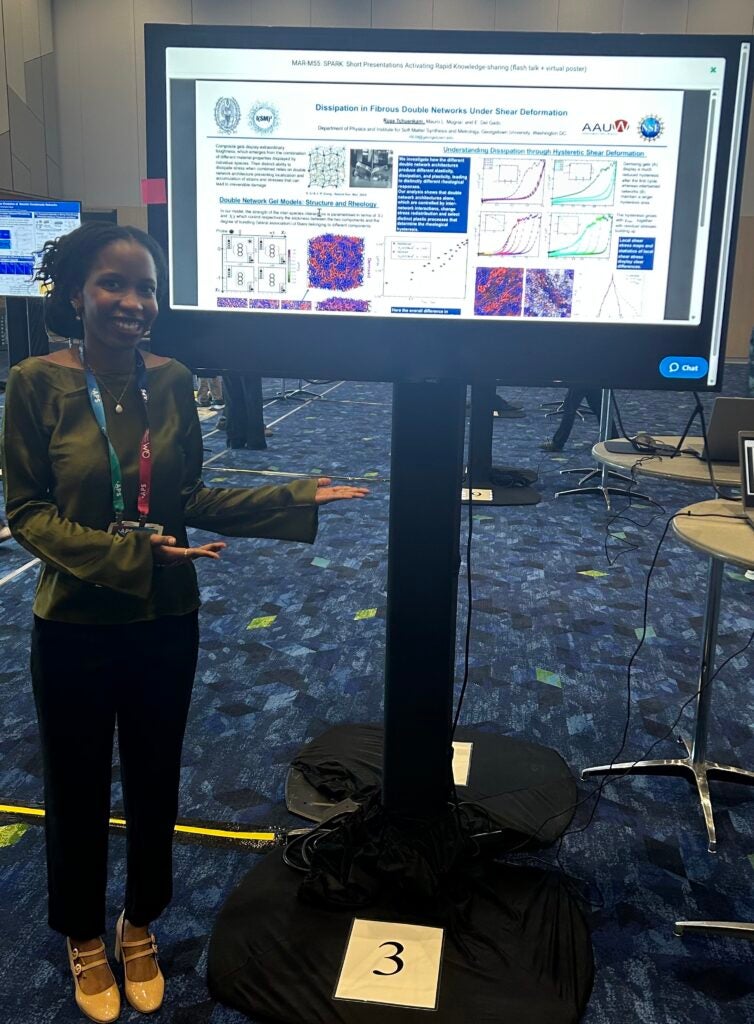
Rose’s work examines how the internal structure of fibrous materials influences how they absorb and dissipate energy. Using advanced 3D molecular dynamics simulations, her research proposes a new framework for understanding material architecture at scales that are often difficult to access experimentally. This work has important implications for fields like bioengineering, where materials such as collagen and the extracellular matrix play a critical role.
She presented her findings in the conference’s SPARK session. In just two minutes, presenters must distill complex research into its most essential insights before continuing discussions during poster sessions. Rose’s ability to communicate her work in this format earned her the APS DSOFT Spark Presentation Award, highlighting both the scientific contribution and the clarity of her presentation.
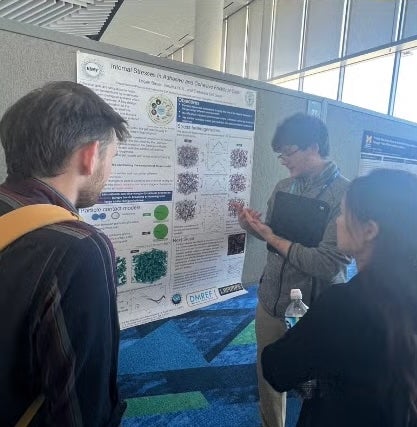
Logan’s research, which earned the APS DSOFT Poster Award, explores how different types of particle interactions shape the structure and behavior of gel-based materials. By introducing more detailed and realistic interaction models, his work captures how subtle differences at the microscopic level can lead to significant changes in material properties.
These findings have broad applications. From food products to pharmaceuticals and cosmetics, understanding how gels behave can inform everything from product stability to shelf life. His research also investigates phenomena like syneresis, the process that causes liquids to separate from gels over time, offering insights that could help industries better predict and control material performance.
The ISM Advantage
Both students emphasized that their success at the conference was built on the foundation of ISM’s support.
For Rose, ISM Fellowship funding alongside the International Women fellowship from the American Association of University Women (AAUW) made it possible to attend and present at the summit, while also supporting the research behind her work. Just as important were the institute’s built-in opportunities for practice and feedback.
For Logan, ISM’s close connection between computational and experimental research groups has been central to advancing his work. By working alongside experimental labs, his team has been able to test theoretical models against real-world observations, strengthening both the accuracy and relevance of their findings.
Looking Ahead
Both Rose and Logan are continuing to build on this work, with new studies and collaborations already underway. Their research aims to bridge the gap between microscopic interactions and large-scale material behavior, an essential step toward designing smarter, more adaptable materials.
Their recognition at the APS Global Summit not only highlights individual achievement, but also reflects the strength of ISM’s interdisciplinary approach, where funding, mentorship, and collaboration come together to support impactful scientific work.