

ISM Professor Dan Blair Contributes to $9M Multidisciplinary Naval Research Initiative
Posted in ISM Stories News Story
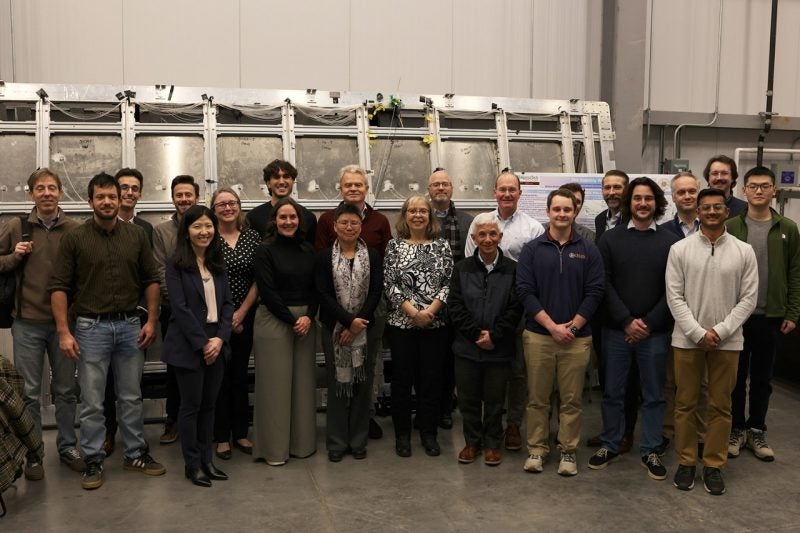
Professor Dan Blair, a member of Georgetown’s Institute for Soft Matter Synthesis and Metrology (ISM), is part of a newly funded $9 million Multidisciplinary University Research Initiative (MURI) led by Virginia Tech and supported by the Office of Naval Research. The five-year project brings together researchers from Cornell University, George Washington University, Georgetown University, and the United States Naval Academy to study the complex interactions between turbulence, biofouling, compliant surfaces, and acoustics in marine environments.
Biofouling begins almost immediately when a vessel enters seawater. Within hours, microorganisms form a thin bacterial film on a ship’s hull that produces sticky substances and enables the growth of algae and other organisms. Over time, this buildup creates rough, uneven surfaces that increase drag and resistance, raise fuel consumption, generate noise and vibrations, and interfere with onboard sensors.
To address this challenge, the interdisciplinary research team will investigate how biological growth interacts with fluid flow and surface materials. The project will focus on three primary research thrusts: developing new measurement techniques, advancing understanding of the biological and materials science behind biofilm formation, and generating unprecedented experimental datasets that capture how turbulence, biofouling, and surface properties interact.
Professor Blair’s research contributes critical expertise in soft matter physics and biological materials. His work focuses on measuring the mechanical properties of soft and living materials using advanced microscopy and rheology techniques. In the context of this project, Blair will help characterize the structure and mechanical behavior of biofilms, providing insight into how these thin biological layers respond to fluid forces and influence flow dynamics.
Because biofouling is a living, evolving system, studying it in controlled laboratory conditions presents significant challenges. To enable repeatable experiments, the team will develop artificial and cultured biofilms that mimic real-world marine growth. Researchers will then test these systems across a series of increasingly complex experimental environments, ranging from small-scale flow channels to large facilities capable of replicating realistic ocean conditions.
By combining expertise in marine microbiology, fluid dynamics, surface chemistry, acoustics, and soft matter physics, the collaboration aims to push the boundaries of measurement and understanding in this complex field. In addition to improving naval vessel performance, the findings may have broader applications, including strategies for managing microbial buildup in industrial systems and improving cleaning and sterilization technologies in medical settings.
Professor Blair’s participation in this major multi-institution effort highlights ISM’s growing role in tackling interdisciplinary challenges at the intersection of physics, biology and engineering.